
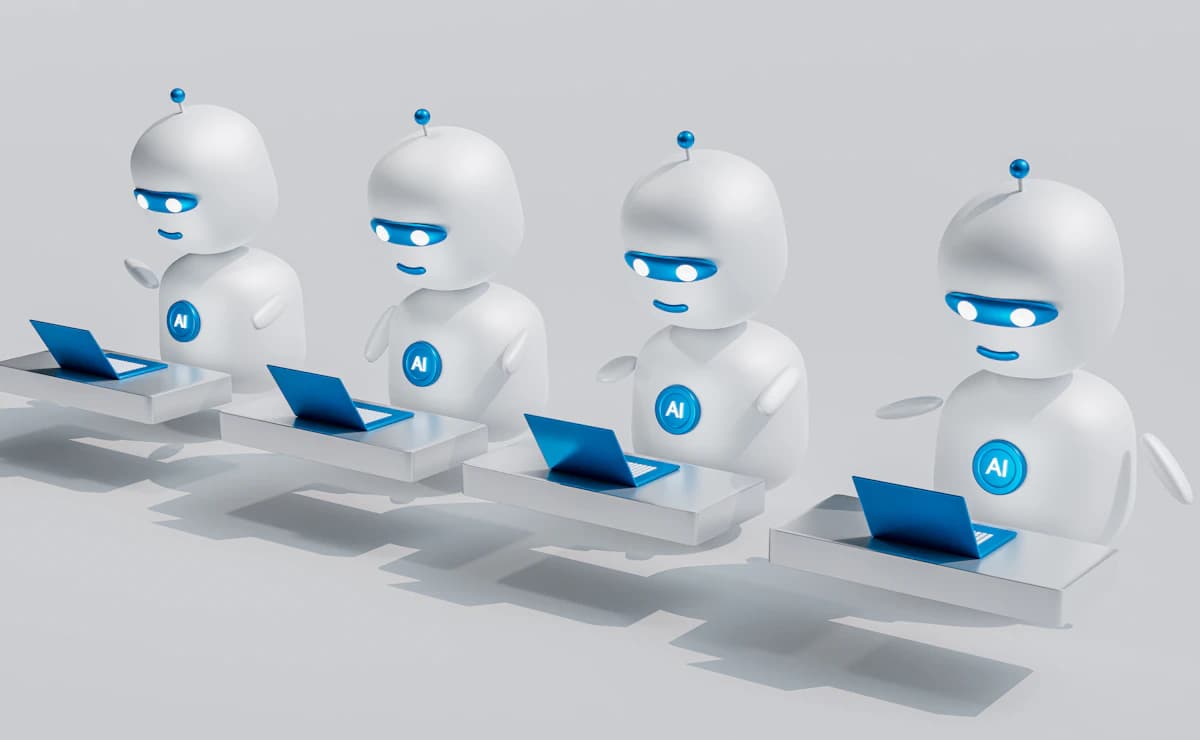
Customer service automation: AI chatbot vs. human agent in 2026
Published on March 9, 2026
Introduction
As we navigate 2026, the question isn't whether to automate customer service anymore—it's how to do it strategically. Customer service automation using AI chatbots has evolved far beyond simple scripted responses, yet many business owners still wonder if they're truly ready to replace human agents entirely. The answer is more nuanced than yes or no.
In 2026, the most successful businesses aren't choosing between AI chatbots and human agents; they're blending both into hybrid customer service ecosystems that deliver speed, personalization, and genuine human connection when it matters most. This article explores the real capabilities, costs, and limitations of both approaches, helping you make data-driven decisions for your specific business needs. Understanding where AI excels and where humans remain irreplaceable is essential for building a customer service strategy that doesn't just cut costs—it genuinely improves customer satisfaction and drives business growth.
Table of contents
- How customer service automation has evolved
- AI chatbots: capabilities and limitations in 2026
- Human agents: still essential for complex interactions
- Hybrid approach: combining chatbots and human support
- Cost comparison: real numbers for your business
- Key metrics to measure success
- Ready to optimize your customer service strategy
- Frequently asked questions
How customer service automation has evolved
The landscape of customer service automation has transformed dramatically over the past few years. In the early 2020s, AI chatbots were often viewed as frustrating obstacles customers had to navigate before reaching real people. Fast-forward to 2026, and the technology has matured significantly. Modern AI chatbots now utilize advanced natural language processing (NLP), machine learning, and contextual understanding that allows them to handle nuanced conversations with remarkable accuracy.
Today's chatbots aren't just pattern-matching machines responding to keywords. They can understand customer intent, remember conversation history across sessions, and even recognize when a situation requires human intervention. Companies like major e-commerce platforms, SaaS providers, and financial institutions have invested heavily in AI chatbot infrastructure, proving that automation can deliver genuine business value when implemented correctly.
The shift from scripted to conversational AI
Early chatbots operated on decision trees—if a customer said X, respond with Y. Modern AI chatbots in 2026 use large language models and contextual awareness to generate responses that feel natural and relevant. This evolution means that customers feel like they're talking to an intelligent assistant rather than a vending machine, which significantly improves satisfaction rates even when dealing with automation.
Integration with existing business systems
The real power of customer service automation in 2026 comes from integration. Leading chatbot solutions now seamlessly connect with CRM systems, knowledge bases, order management platforms, and payment gateways. When a chatbot can access your customer's purchase history, support tickets, and account information in real-time, it can provide personalized solutions that many customers won't need to escalate to human agents.
AI chatbots: capabilities and limitations in 2026
AI chatbots have reached a level of sophistication where they can genuinely solve customer problems without human intervention. However, understanding their realistic capabilities and limitations is crucial for implementing them effectively.
What AI chatbots excel at in 2026
Availability and response time: AI chatbots operate 24/7/365 without fatigue, providing instant responses to customer inquiries. When a customer contacts you at 2 AM on a Sunday, your chatbot is ready. This alone has become a competitive advantage—studies show that 67% of customers expect customer service to be available outside business hours.
Handling high volume: A single well-trained AI chatbot can handle thousands of concurrent conversations, something that would require a proportionally massive human team. During peak periods like holiday seasons or product launches, chatbots prevent your customer service from becoming a bottleneck.
Consistency and accuracy: AI chatbots deliver the same quality of response every time, without the variability that comes with human agents who might be tired, distracted, or having a bad day. They never forget company policies or product details.
Rapid resolution of common issues: Approximately 70-80% of customer service inquiries are routine questions—password resets, order status, basic troubleshooting, billing questions, and frequently asked queries. AI chatbots can resolve these in seconds without requiring human involvement.
Data collection and analysis: Every chatbot conversation generates data. Advanced systems analyze these interactions to identify common pain points, emerging issues, and areas where customer experience can be improved. This intelligence feeds directly into product development and marketing strategies.
Current limitations of AI chatbots
Complex emotional situations: When customers are frustrated, angry, or dealing with sensitive issues, they need empathy and emotional intelligence that AI still struggles to provide authentically. A chatbot can recognize negative sentiment, but it can't truly understand the emotional weight of a customer's problem.
Novel or unexpected scenarios: AI chatbots operate best within their training parameters. When customers present situations the chatbot wasn't trained on, or when they ask creative questions outside standard support topics, the chatbot's performance degrades. Humans excel at improvisation and creative problem-solving.
Context beyond text: While chatbots can read words, they miss body language, tone nuance, hesitation, and other non-verbal cues that humans naturally pick up on. This matters significantly in high-stakes situations like cancellation requests or complaint handling.
Building genuine relationships: For businesses where customer loyalty and lifetime value depend on relationship-building, AI interactions feel transactional. Customers appreciate human touch points, especially for VIP accounts or long-term clients.
Pro Tip: Use AI chatbots to handle the predictable 70-80% of routine inquiries, freeing your human agents to focus on the complex, high-value interactions that actually build customer loyalty and generate referrals.
Human agents: still essential for complex interactions
Despite the impressive capabilities of AI, human customer service agents remain indispensable for 2026 businesses that want to maintain customer relationships and handle complex scenarios.
Where human agents outperform chatbots
Complex problem-solving: When a customer's issue requires troubleshooting across multiple systems, creative thinking, or analysis of nuanced information, humans excel. A human agent can understand context that a chatbot might miss—like understanding that a customer's technical issue is actually stemming from a workflow problem in their business, not a software bug.
Empathy and crisis management: When customers are upset, in crisis, or dealing with sensitive matters, human empathy becomes essential. A skilled agent can de-escalate frustration, provide reassurance, and transform a negative experience into a loyalty-building moment. This emotional intelligence is difficult to replicate authentically with AI.
Account relationship management: For enterprise clients or high-lifetime-value customers, having a dedicated human point of contact creates trust and perceived value. These relationships often drive retention and expansion opportunities that pure transactional interactions can't.
Negotiation and flexibility: Human agents can make judgment calls, offer discretionary discounts, or find creative solutions to unique situations. They can evaluate the customer's history, lifetime value, and circumstances to make decisions that maximize both satisfaction and company profitability.
The human advantage for retention
Research in 2026 shows that customers are more likely to remain loyal to companies where they've had meaningful human interactions. While chatbots are excellent for reducing friction and providing quick answers, human agents are the ones who turn satisfied customers into advocates.
Hybrid approach: combining chatbots and human support
The most effective customer service strategy in 2026 isn't about choosing one or the other—it's about orchestrating a seamless hybrid system where AI and humans work together, each handling what they do best.
The ideal hybrid model
Tier 1 - AI chatbot triage: All incoming customer inquiries first encounter your AI chatbot. The chatbot's job is to understand the customer's needs, ask clarifying questions, and attempt to resolve the issue immediately if possible. For routine questions, this tier resolves them in seconds.
Tier 2 - AI escalation: If the chatbot detects complexity, emotional intensity, or a situation outside its training, it smoothly escalates to a human agent—but it doesn't start the conversation from zero. The chatbot passes along context: what the customer asked, what solutions were already attempted, relevant account information, and the reason for escalation.
Tier 3 - Human agent empowerment: Your human agents receive these escalated cases with full context, allowing them to jump directly into meaningful problem-solving. They spend time on high-value interactions rather than gathering basic information or repeating questions the chatbot already asked.
Real-world hybrid example
A software-as-a-service (SaaS) company with 50,000 customers implements this model:
- Day 1-5: Chatbot handles 8,000 inquiries daily (password resets, billing questions, feature explanations, documentation lookups). Resolution rate: 75%, average handle time: 90 seconds.
- Escalated cases: 2,000 inquiries daily escalated to humans due to complexity, negative sentiment, or custom requests.
- Human team: 8 agents handle the 2,000 escalations, achieving 95% customer satisfaction. Average handle time: 8 minutes, but these interactions often prevent churn or generate upsells.
- Result: Customer satisfaction increases from 78% (human-only model) to 89% (hybrid model), while support costs decrease 35%.
Building the hybrid system
Successful hybrid systems require three components: first, a well-trained AI chatbot with clear escalation logic and contextual awareness; second, robust integration between your chatbot and CRM/support platforms so nothing falls through the cracks; and third, human agents trained to work with AI rather than competing against it—understanding that their role is high-value problem-solving, not information gathering.
Cost comparison: real numbers for your business
Understanding the financial implications of customer service automation is critical for decision-making. Let's examine realistic costs for different approaches in 2026.
Full human support model
| Metric | Cost |
|---|---|
| Average agent salary (fully loaded) | $45,000 USD/year |
| Team size for 10,000 inquiries/month | 5-7 agents |
| Annual personnel cost | $225,000-$315,000 USD |
| Software (ticket system, CRM) | $200-500 USD/month ($2,400-6,000 USD/year) |
| Training and onboarding | $3,000-5,000 USD/agent/year ($15,000-35,000 USD) |
| Total annual cost | $242,400-356,000 USD |
| Cost per inquiry | $2.02-2.97 USD |
Full AI chatbot model
| Metric | Cost |
|---|---|
| AI chatbot platform (enterprise) | $1,500-3,000 USD/month ($18,000-36,000 USD/year) |
| Integration and setup | $5,000-15,000 USD one-time |
| Maintenance and training updates | $2,000-5,000 USD/year |
| Hosting and API costs | $500-2,000 USD/month ($6,000-24,000 USD/year) |
| Total annual cost | $30,000-77,000 USD |
| Cost per inquiry | $0.25-0.64 USD |
Hybrid model (chatbot + human agents)
| Metric | Cost |
|---|---|
| AI chatbot platform | $2,000-3,500 USD/month ($24,000-42,000 USD/year) |
| Reduced human team (2-3 agents) | $90,000-135,000 USD/year |
| Software and integration | $5,000-10,000 USD/year |
| Training | $6,000-10,000 USD/year |
| Total annual cost | $125,000-197,000 USD |
| Cost per inquiry | $1.04-1.64 USD |
Cost analysis insights
The pure AI chatbot model offers the lowest per-inquiry cost, but it achieves this by only addressing routine issues. The hybrid model represents a sweet spot: it reduces overall support costs while improving customer satisfaction because human agents focus exclusively on complex, high-value interactions.
Pro Tip: Calculate your average customer lifetime value. If it's above $500, USD investing in hybrid support almost always delivers better ROI than pure automation, because one retained customer is worth more than 200 routine support interactions.
For businesses generating 10,000 monthly inquiries, the hybrid approach costs roughly $15,000-16,000 USD monthly while achieving significantly better outcomes than either pure approach alone.
Hidden costs to consider
Training: AI chatbots require initial training on your products, services, and support policies. Budget $5,000-15,000 USD for proper setup and ongoing training as your offerings change.
Integration: Connecting chatbots to your existing systems (CRM, payment processors, knowledge bases) isn't automatic. Integration costs typically range $5,000-20,000 USD depending on system complexity.
Monitoring and maintenance: AI systems require ongoing monitoring to catch hallucinations, outdated information, or performance degradation. Budget 10-15 hours/month for a dedicated team member.
Key metrics to measure success
Simply implementing a chatbot or hybrid system isn't enough—you need to measure whether it's actually improving customer experience and business outcomes.
Essential chatbot metrics
First contact resolution (FCR): The percentage of inquiries solved without escalation. Target: 70-85% for routine issues. If your chatbot is achieving only 40% FCR, it's creating more work for humans, not less.
Customer satisfaction (CSAT): Measure satisfaction specifically for chatbot interactions separately from human interactions. In 2026, customers expect 7.5+ out of 10 for chatbot interactions, 8.5+ for human interactions.
Escalation rate: What percentage of conversations are escalated to humans? Target: 15-25%. If your escalation rate is above 40%, your chatbot either isn't trained well enough or is attempting issues beyond its capability.
Average response time: Chatbots should respond within 2-5 seconds. If response time exceeds 10 seconds, customers perceive the system as slow, which defeats the purpose of automation.
Conversation abandonment rate: The percentage of customers who start a conversation but don't complete it. Rates above 20% indicate the chatbot is frustrating customers rather than helping them.
Human agent metrics
Average handle time (AHT): Time spent on each support interaction. In hybrid systems, expect AHT to increase slightly because agents are handling more complex issues, but satisfaction should increase proportionally.
Customer effort score (CES): How easy was it to resolve your issue? Target: 8+ out of 10. Customers who find support effortless are significantly more likely to remain loyal.
First-contact resolution by human agents: The percentage of escalated issues that humans resolve without requiring callbacks or additional follow-ups. Target: 85-95%.
Business impact metrics
Customer retention rate: Track whether customers who receive hybrid support have higher retention than those who only interact with humans or only with chatbots.
Average resolution cost per inquiry: Calculate total support costs divided by total inquiries handled. Track this monthly to measure the financial impact of your automation strategy.
Net Promoter Score (NPS): Measure whether your overall customer satisfaction and willingness to recommend improves with your hybrid approach.
In 2026, progressive companies are also measuring sentiment trend analysis—using AI to automatically analyze customer conversations to identify emerging dissatisfaction patterns before they become widespread issues. This requires integration with platforms that can auto-generate content and intelligence from support conversations, similar to how blog content can be auto-generated using AI—understanding that data becomes insights becomes strategy.
Ready to optimize your customer service strategy
The evidence is clear: in 2026, the most successful customer service operations blend AI chatbot capabilities with human expertise. Whether you're currently operating with only human agents or have already deployed a chatbot, understanding the optimal balance for your specific business is crucial.
Zerpia's AI chatbot solution is built to integrate seamlessly into hybrid customer service models, handling routine inquiries while providing the context and escalation intelligence that empowers your human team. Start transforming your customer service today.
Conclusion
The customer service landscape in 2026 demands strategic thinking about automation, not blind faith in it. AI chatbots have become sophisticated enough to deliver genuine customer value—but only when deployed thoughtfully in situations where their strengths align with your business needs. The hybrid approach, combining AI and human expertise, consistently outperforms pure automation or purely human support.
The key to success lies in understanding your specific customer base, defining clear boundaries about what automation should handle, investing adequately in training and integration, and maintaining the human touch where it matters most. Ready to build your customer service strategy for 2026? Explore how Zerpia's AI chatbot solution can help you create a hybrid customer service system that genuinely improves both customer satisfaction and your bottom line.
Frequently asked questions
Zerpia Editorial Team / César Solar
AI Solutions Architect |25+ years transforming businesses with technology
The Zerpia editorial team combines expertise in development, integrations, and digital strategy to produce rigorous, actionable technical content. Our goal is to help businesses and entrepreneurs understand and leverage AI as a real competitive advantage.
Share article