
How to build a content strategy with AI in under 30 minutes
Published on March 9, 2026
Introduction
Building a solid content strategy typically takes weeks of research, planning meetings, and endless spreadsheets. But in 2026, artificial intelligence has fundamentally changed how fast and efficiently you can create a strategic content roadmap. The question isn't whether AI can help you build a content strategy—it absolutely can—but rather how to leverage it effectively to go from zero to a complete, actionable plan in just 30 minutes.
This matters because time is your most finite resource. Whether you're a solopreneur, a small business owner, or a marketing manager juggling multiple responsibilities, waiting months to launch your content strategy means losing competitive ground. Your competitors aren't waiting, and neither should you. With the right AI tools and a clear process, you can establish keyword priorities, identify content gaps, map your audience journey, and create a publishing calendar—all before lunch.
In this guide, we'll walk you through a proven method to build a legitimate, data-driven content strategy using AI, breaking down each phase so you can execute it efficiently and start seeing results immediately.
Table of contents
- Why AI speeds up content strategy planning
- The 30-minute framework for AI-powered content strategy
- Step 1: Define your core pillars and audience in 5 minutes
- Step 2: Conduct AI keyword research in 7 minutes
- Step 3: Map content topics and gaps in 8 minutes
- Step 4: Build your publishing calendar in 10 minutes
- Ready to launch your AI-powered content strategy?
- Frequently asked questions
Why AI speeds up content strategy planning
Content strategy has always been about understanding your audience, identifying market gaps, and creating a roadmap for consistent publishing. Traditionally, this required extensive competitor analysis, focus groups, and manual research that could stretch over weeks or months. In 2026, AI eliminates the busywork while preserving—and even enhancing—the strategic thinking that matters.
Here's what makes AI exceptional for content planning: it processes vast amounts of data instantly. An AI tool can analyze thousands of competitor articles, identify trending topics, extract keyword data, and surface audience pain points faster than any human team could manage in a month. It doesn't get tired, doesn't need coffee breaks, and doesn't suffer from decision fatigue.
More importantly, AI removes the blank-page problem. Instead of staring at an empty document wondering where to start, AI gives you structured recommendations based on real data. You're not guessing about what your audience wants—you're working from evidence.
The speed advantage compounds when you're using multiple AI tools in sequence. Keyword research AI feeds into topic clustering AI, which informs your content calendar. Each step builds on the previous one, creating momentum and clarity that would take a human strategist hours to develop manually.
Pro Tip: Before you start, clarify your business goal. Are you trying to drive leads, establish authority, increase sales, or build community? Your 30-minute strategy should align with one primary business outcome. This focus ensures every piece of content you plan actually supports your bottom line.
The 30-minute framework for AI-powered content strategy
The most efficient content strategy framework divides your planning into four distinct phases, each with a specific time allocation. This isn't arbitrary—these time blocks are designed to maximize the AI tool's efficiency while leaving room for your strategic judgment.
The framework assumes you're starting with basic knowledge of your business, audience, and industry. If you need to research your market first, you'll want to extend this timeline. But if you already know who you serve and what problems you solve, this 30-minute sprint will produce a legitimate, actionable content strategy.
Phase breakdown:
- Phase 1 (5 minutes): Core strategy definition
- Phase 2 (7 minutes): Keyword research and analysis
- Phase 3 (8 minutes): Content topic mapping
- Phase 4 (10 minutes): Publishing calendar and next steps
The remaining time acts as a buffer for decision-making and unexpected questions. Let's break down each phase with precision.
Step 1: Define your core pillars and audience in 5 minutes
Your content pillars are the broad categories that organize all your content. Think of them as the main themes your business addresses. For a B2B software company, pillars might be "implementation guides," "industry trends," and "customer success stories." For an e-commerce brand, they could be "product education," "style tips," and "sustainability."
Why this matters for strategy: Without clear pillars, your content becomes scattered and unfocused. You end up creating content that doesn't reinforce your key messages or serve your business goals.
To define your pillars in just 5 minutes, use an AI tool or your own prompt-based thinking:
- List your three main value propositions (what your business does better than competitors).
- Ask yourself: "What questions would my ideal customer ask if they were evaluating my solution?"
- Group those questions into 3-5 broad themes.
For example, if you sell project management software, your pillars might be:
- Work efficiency: How to manage teams and deadlines faster
- Integration: How to connect tools and reduce context switching
- Remote work: How to enable distributed teams
- Compliance: How to maintain security and audit trails
At this stage, you're not overthinking it. You're creating a framework that AI will use to generate more specific content recommendations in the next phases.
Include a brief audience definition: Who is your primary buyer persona? What industry are they in? What's their job title? What keeps them awake at night? Write this in one paragraph. AI will use this context to refine all subsequent recommendations.
Step 2: Conduct AI keyword research in 7 minutes
This is where AI truly accelerates your process. Traditionally, keyword research involves hundreds of manual searches and competitive analysis. With AI-powered tools, you can extract the most relevant, high-intent keywords in minutes.
What you're looking for:
- Keywords with search volume (people are actually searching for these)
- Keywords with low-to-medium competition (you can realistically rank)
- Keywords that align with your content pillars (they drive relevant traffic)
Using Zerpia SEO AI, you can input your core pillars and target audience, and the tool immediately surfaces keyword opportunities. For example:
If one pillar is "work efficiency," the tool might identify:
- "how to manage remote team productivity" (890 searches/month, medium difficulty)
- "project tracking software for small teams" (1,200 searches/month, medium-high difficulty)
- "best practices for distributed team communication" (450 searches/month, low difficulty)
The beauty of AI keyword research is that it doesn't just give you a list—it provides context. You see search volume, competition level, and relevance. You can quickly prioritize which keywords to target first.
Framework for 7 minutes:
- Minutes 1-2: Input your industry and pillars into the AI tool
- Minutes 2-5: Review the generated keyword list, note 5-10 primary keywords that excite you
- Minutes 5-7: Cross-reference those keywords with your audience definition—do they solve real problems for your target customers?
By the end of this phase, you should have a ranked list of 5-10 keywords that will form the backbone of your content strategy.
Pro Tip: Prioritize keywords that indicate intent to solve a problem (like "how to," "best way to," "what is") over purely informational keywords. These are more likely to convert into business results.
Step 3: Map content topics and gaps in 8 minutes
Now that you have keywords, you need to turn them into specific content topics. This is where strategy meets creativity. You're not writing the content yet—you're planning what topics to cover and identifying what's missing in the market.
AI excels at topic clustering. It can take your 5-10 keywords and organize them into topic groups, then suggest additional related topics that would strengthen your coverage.
The content mapping process:
Start by asking your AI tool: "Given these keywords and this audience, what content topics should I create?" A good AI tool will generate suggestions like:
-
Topic cluster: Project management fundamentals
- "Getting started with project management" (beginner)
- "Project management methodologies explained" (intermediate)
- "Scaling project management across departments" (advanced)
-
Topic cluster: Remote team management
- "Tools for managing distributed teams" (product-focused)
- "Building team culture remotely" (strategy-focused)
- "Time zone management for global teams" (operational)
This clustering serves two purposes: it shows you how topics relate to each other (helping you create content series and interlinked articles), and it reveals gaps. If you see that most competitor content covers "remote tools" but almost nobody addresses "building culture remotely," that's a gap—an opportunity to own a topic.
Within these 8 minutes:
- Minutes 1-3: Generate AI topic suggestions using your keywords
- Minutes 3-6: Manually review and organize topics into 3-5 content clusters
- Minutes 6-8: Identify 2-3 content gaps where competitors are weak but your audience has need
Gap identification is powerful because it means you can create content that ranks easier (less competition) while still addressing real audience needs.
Step 4: Build your publishing calendar in 10 minutes
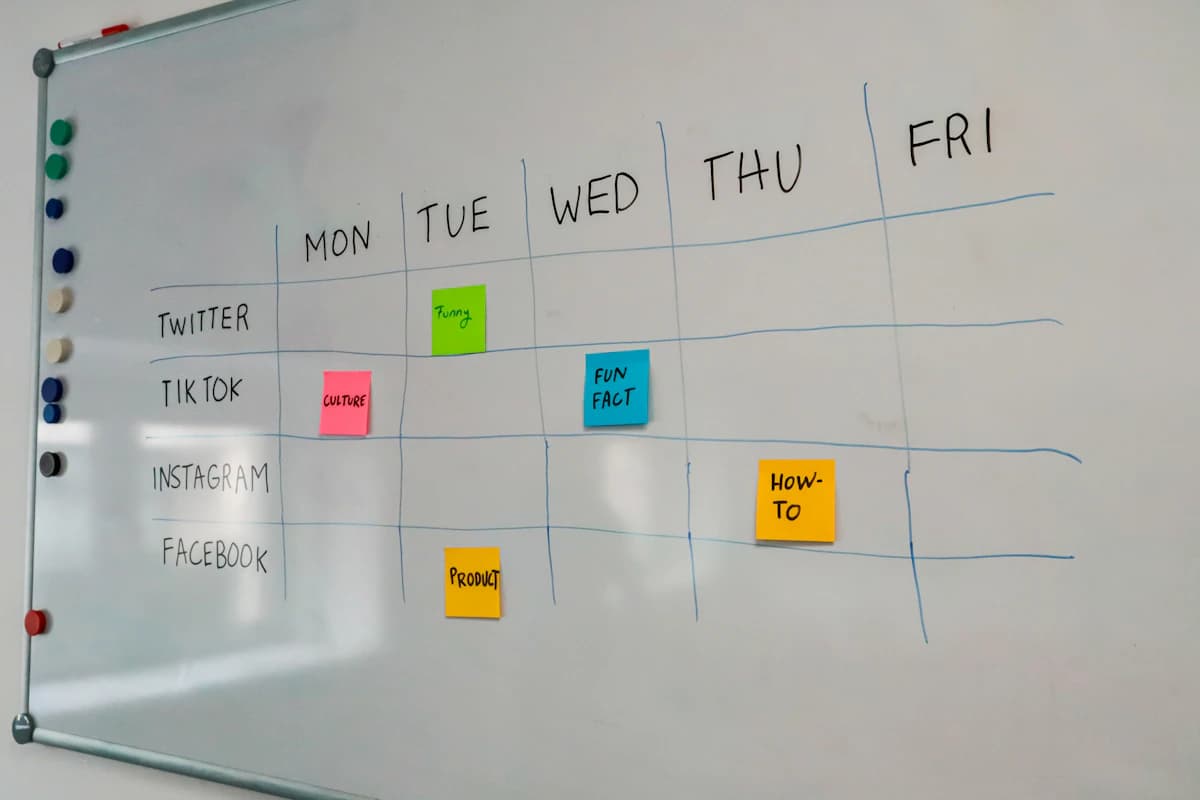
A content strategy without a publishing schedule is just a wish list. The calendar is what transforms planning into action. This final 10-minute phase creates your first 90-day content roadmap.
Your publishing calendar should specify:
- What topic (based on your clusters)
- When it publishes
- What format (blog post, guide, video, infographic)
- Which primary keyword it targets
- Which content pillar it serves
Sample 90-day content calendar structure:
| Week | Topic | Format | Primary Keyword | Pillar | Status |
|---|---|---|---|---|---|
| 1 | Getting started with project management | Blog post | how to manage remote team productivity | Work efficiency | Planned |
| 2 | Best project management tools reviewed | Comparison guide | project tracking software for small teams | Integration | Planned |
| 3 | Building team culture remotely | Guide + checklist | best practices distributed team communication | Remote work | Planned |
| 4 | Compliance and security in project management | Blog post | project management compliance requirements | Compliance | Planned |
| 5 | Advanced time zone strategies | Case study | managing global teams across time zones | Remote work | Planned |
Within these 10 minutes:
- Minutes 1-3: Use AI to suggest an optimal publishing sequence (what should publish first to build momentum?)
- Minutes 3-7: Plug topics into a calendar, spacing them strategically (frequency depends on your capacity)
- Minutes 7-10: Assign formats and platforms, note any dependencies (e.g., "blog post #3 should link to blog post #1")
The calendar doesn't need to be perfect. It's a living document you'll adjust based on results and priorities. What matters is that you have a concrete plan with specific publish dates, which forces accountability and keeps your strategy moving.
Once your calendar exists, you can leverage AI-powered tools like Zerpia Blog AI to actually generate the content efficiently, ensuring your strategy translates into published work consistently.
Real-world example: B2B SaaS content strategy in 30 minutes
Let's walk through a concrete example. Imagine you're the marketing manager for a mid-market CRM platform targeted at small services businesses.
Phase 1 (5 minutes): You identify three pillars:
- Pipeline management for small teams
- Customization without coding
- Customer retention through data
Your audience is "operations managers at services firms with 10-50 employees, managing sales and customer relationships manually."
Phase 2 (7 minutes): AI keyword research surfaces:
- "CRM for service businesses" (1,100 monthly searches, high competition)
- "pipeline management software for small teams" (650 monthly searches, medium competition)
- "how to implement CRM without IT help" (280 monthly searches, low competition)
- "customer retention strategies SaaS" (420 monthly searches, medium competition)
Phase 3 (8 minutes): You cluster these into three content groups:
- CRM basics for service businesses (3-4 pieces)
- Implementation and customization without coding (2-3 pieces)
- Customer retention case studies (2-3 pieces)
You notice competitors heavily cover "CRM comparison guides" but almost nobody addresses "implementing CRM in service businesses without an IT team"—your gap.
Phase 4 (10 minutes): You build your 90-day calendar:
- Week 1: "CRM for service businesses: complete guide"
- Week 2: "Implementing CRM without IT support: step-by-step"
- Week 3: "Pipeline management for small teams: tools and tactics"
- Week 4: "How to customize CRM for your service business" (no coding required)
- Week 5: "Customer retention case study: [Your Client Name]"
And so on. By the 30-minute mark, you have a direction, priorities, and a publishing schedule.
This example shows that the 30-minute framework isn't theoretical—it works for real businesses solving real problems. The speed doesn't sacrifice quality because you're leveraging AI to handle the research and pattern recognition work that would otherwise take days.
As you continue building out this strategy, you'll want to ensure your content aligns with your broader technical SEO efforts. Our guide on Technical SEO for small business: how AI makes optimization accessible covers how to optimize your content structure and website foundation for maximum visibility.
Ready to launch your AI-powered content strategy?
Now that you have a framework and a real 30-minute plan, the next step is execution. AI can help you not just plan your strategy but create the content itself. Zerpia's suite of AI tools—from keyword research to content generation—turns your 30-minute strategy into a published, growing content library that drives traffic and leads consistently.
Start your free trial → https://hub.zerpia.com/admin/en/register
Closing thoughts
Building a content strategy with AI isn't just faster—it's smarter. You're removing the guesswork and letting data-driven insights guide your priorities. In 2026, this kind of efficiency isn't a luxury; it's essential for staying competitive.
The framework we've outlined takes you from blank slate to actionable plan in 30 minutes. But the real power emerges when you connect strategy to execution. Our Blog AI service transforms your strategic content calendar into published, SEO-optimized articles automatically, so your plan doesn't sit in a spreadsheet—it drives results.
Frequently asked questions
Zerpia Editorial Team / César Solar
AI Solutions Architect |25+ years transforming businesses with technology
The Zerpia editorial team combines expertise in development, integrations, and digital strategy to produce rigorous, actionable technical content. Our goal is to help businesses and entrepreneurs understand and leverage AI as a real competitive advantage.
Share article